
Dry Verge Caps in Stoke-on-Trent | What They Are & Why Homes Need Them
TL;DR
Dry verge caps are plastic covers that fit along the sloping edge of your roof where it meets the gable wall. They replace old mortar pointing, which cracks over time and lets in water. Most homes in Stoke-on-Trent were built with mortar verges that will fail eventually. Fitting dry verge caps is a straightforward, long-lasting fix with no ongoing maintenance.
What are dry verge caps?
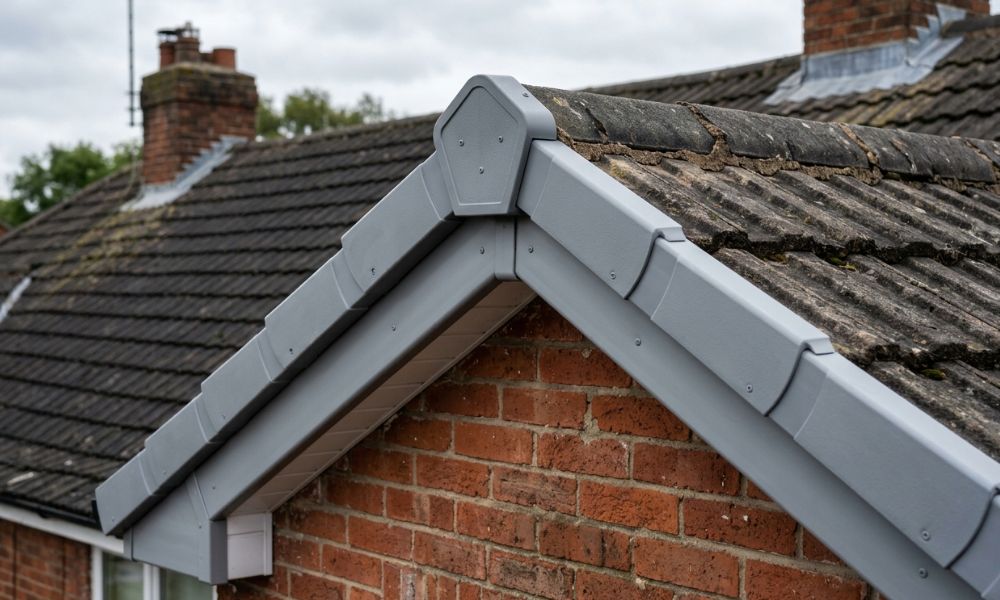
Dry verge caps are plastic profiles that fit along the verge of a roof. The verge is the sloping edge where the roof tiles meet the gable end wall the triangular section at the side of the house. On most older properties, this joint was sealed with mortar. Dry verge caps replace that mortar joint with a purpose-made cover that clips mechanically onto the tiles and the barge board.
They come in a range of colours to match common tile types, typically grey, brown and terracotta. The profiles interlock along the full length of the verge and finish with a ridge cap at the top. Once fitted, the edge of the roof is fully protected without any cement or sealant involved.
Why do Stoke-on-Trent homes need them?
Most houses in Stoke-on-Trent were built between the 1930s and 1970s, and the vast majority originally had mortar verges. That mortar does its job for a while. But it does not last.
The problem is freeze-thaw cycles. In a typical Staffordshire winter, the mortar absorbs moisture and then freezes. Over several seasons this causes it to crack and break away. Once the pointing fails, wind can get under the edge tiles. Water gets behind the verge and sits against the barge board. On older properties with timber barge boards, that means rot. By the time you notice a damp patch on a bedroom ceiling, the damage has usually been building for a while.
Areas like Fenton, Longton, Burslem and Tunstall have a high proportion of older terrace and semi-detached properties with original mortar verges that have never been touched. Newcastle-under-Lyme and Congleton are the same. If your house is more than 30 years old and the verge has not been re-pointed or capped, it is worth having it looked at.
Mortar verge vs dry verge: what is the difference?
A traditional mortar verge is bedded in sand and cement, applied directly on top of the edge tiles and the barge board. When fresh, it bonds well. The issue is that mortar is rigid and roof structures move slightly, particularly during cold spells. That movement is enough to cause cracking.
Once the mortar cracks, a few things follow. Wind lifts the edge tiles. Water sits behind the pointing. If the barge board is timber, it rots. Eventually the mortar falls away in sections and the verge is left with no protection at all.
Dry verge caps work differently. They grip the tiles mechanically rather than relying on adhesion. There is no mortar to crack and no bedding to fail. Most systems are also designed to allow a small amount of roof movement without affecting the seal. Reputable dry verge systems carry manufacturer guarantees of 25 to 40 years.
How are dry verge caps installed?
For a standard semi-detached property, fitting dry verge caps is usually a one-day job.
First, any existing mortar is removed. This is done carefully to avoid disturbing the tiles underneath. Once the verge is clear, installation starts at the eaves and works up the slope. A starter piece fits at the bottom, then the main profiles clip and interlock up to the ridge. A purpose-made ridge cap seals the top.
The caps clip firmly onto the edge tiles and are fixed to the barge board where the design requires it. Once fitted, the verge is sealed without mortar or sealant. There is nothing to re-point and nothing to maintain.
If the barge boards are rotten or any edge tiles are cracked, those should be sorted before the dry verge system goes on. It is common to address both at the same time. If you are already having the fascias and soffits replaced, adding dry verge caps to the same visit keeps access costs down.
![Comparison showing crumbling mortar verge on the left and clean new dry verge caps fitted on the right]](https://potteriesfascias.co.uk/wp-content/uploads/2026/03/dry-verge-cap-2-1.jpg)
How much do dry verge caps cost in Stoke-on-Trent?
Cost depends on the size of the property and how many verges need capping. The condition of the existing mortar affects it too. Deep, well-bedded mortar takes longer to remove than old pointing that is already loose. As a rough guide:
- End-of-terrace with one exposed gable: £150 to £300
- Standard semi-detached with two gable ends: £300 to £500
- Detached house with two or more verges: £400 to £750
Scaffolding is not usually needed for dry verge work. Most jobs can be done safely from ladders. If the job also involves fascia board replacement or roof repairs, scaffolding may already be going up anyway, which keeps the overall cost down.
If you want an accurate figure for your property, the only way to get one is a proper look at the roof. We offer free no-obligation quotes across Stoke-on-Trent, Newcastle-under-Lyme and Congleton.
Are dry verge caps worth it?
For most homes, yes. The mortar verge will fail at some point regardless. Getting ahead of it with a dry verge system means you avoid the downstream problems rotten barge boards, damaged tile edges and water ingress that tend to follow once the pointing breaks down.
The alternative is re-pointing in mortar, which buys time but does not solve the underlying problem. Mortar verges need re-pointing every 10 to 15 years in a climate like Staffordshire’s. A dry verge system fitted once, properly, should last the life of the roof.
If you are buying or selling a property and a surveyor has flagged the verge, dry verge caps are a straightforward way to address the note. Most buyers and mortgage lenders are satisfied once a dry verge system is in place.
Ready to get a quote?
We fit dry verge caps across Stoke-on-Trent, Newcastle-under-Lyme, Congleton and the surrounding areas. Call us on 07351 639478 or get in touch here for a free no-obligation quote.
-
What is the difference between a dry verge and a mortar verge?
A mortar verge is sealed with sand and cement applied along the roof edge. It works when new but cracks over time as the roof moves and freezes through winter. A dry verge system uses interlocking plastic caps that clip mechanically onto the tiles without any mortar. There is nothing to crack, nothing to re-point and no ongoing maintenance required.
-
How long do dry verge caps last?
Most reputable dry verge systems carry manufacturer guarantees of 25 to 40 years. In practice, a quality uPVC system fitted correctly should last the life of the roof. Unlike mortar, the caps do not absorb water, so they are not vulnerable to freeze-thaw damage over winter.
-
Do dry verge caps work on all roof types?
Dry verge caps are suitable for most pitched roofs with concrete interlocking tiles or plain clay tiles. They are not designed for slate roofs, which use a different fixing method at the verge. If you are unsure whether your roof type is suitable, we can check when we come out to quote.
-
Will dry verge caps match my existing roof tiles?
Dry verge caps are available in grey, brown, terracotta and anthracite to suit the most common tile colours in Stoke-on-Trent. They will not be an exact colour match in every case, but they blend well with most standard concrete and clay tiles. We will bring samples when we quote so you can see the options against your roof.
-
How much do dry verge caps cost to fit in Stoke-on-Trent?
For most Stoke-on-Trent properties, dry verge installation costs between £150 and £750 depending on property size, the number of gable ends and the condition of the existing mortar. An end-of-terrace with one exposed gable typically sits at the lower end. A detached property with two or more verges sits at the higher end. We provide free written quotes with no obligation — call 07351 639478 to arrange a visit.