
Do you need scaffolding to replace soffits and fascias?
Do You Need Scaffolding to Replace Soffits and Fascias? – Potteries Fascias Guide
Replacing soffits and fascias is one of the best ways to improve your home’s roofline and protect it from the elements. These components aren’t just for show – they shield your roof, keep pests out, and support your guttering system. But if you’re thinking about replacing them, one question often comes up: do you need scaffolding to replace soffits and fascias?
Quick answer: a full fascia and soffit replacement on a two-storey house usually needs scaffolding or a mobile tower, because the work is long, heavy and done at height. Bungalows, short sections and small gutter repairs can often be done safely from ladders. Replacing guttering on its own sits in between: a straightforward run on a two-storey house is often done from ladders or a tower, while taller or awkward properties need a scaffold.
As a Stoke-on-Trent based company with over 20 years’ experience, Potteries Fascias has carried out countless fascia and soffit replacements across the area. Here’s our expert insight on whether scaffolding is needed and why it matters for safety and quality.
What Are Soffits and Fascias?
Before we get into access requirements, it helps to understand these roofline elements:
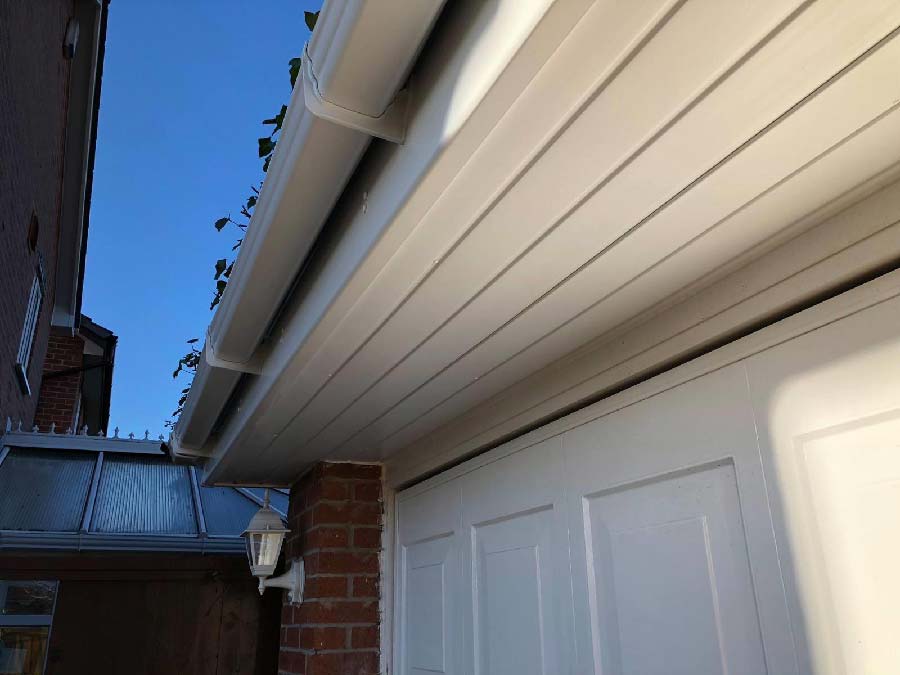
- Fascias – The vertical board running along the roof edge, supporting guttering and sealing the roofline.
- Soffits – The horizontal underside of the fascia, bridging the gap between the wall and the roofline, often vented to allow airflow.
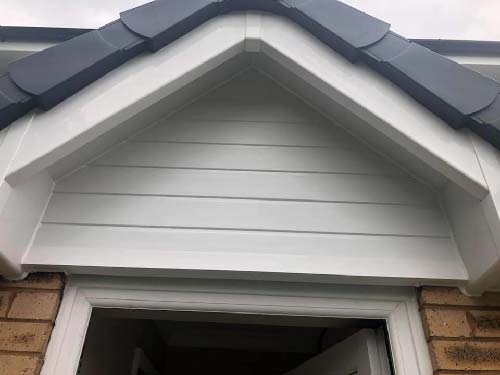
- Verges – The edge of the roof at the gable end, finished either in mortar or with uPVC roof end caps.
These parts are exposed to wind, rain, and debris, meaning they can become worn or damaged over time. Where water has already worked past the roofline and into the roof covering itself, that is a roof repair job rather than a roofline one, and it is worth having both assessed at the same visit.
Do You Need Scaffolding for Replacement Work?
In many cases, yes – scaffolding or a safe access platform is highly recommended for replacing soffits and fascias. Here’s why:
- Height and Safety – Fascias and soffits sit at roof height, usually several metres above the ground. Ladders alone may not be stable enough, especially for longer runs.
- Steady Working Area – Replacement often involves removing old boards, fitting new uPVC boards, and aligning guttering. A stable platform allows installers to work more precisely.
- Efficiency – Scaffolding enables multiple workers to operate safely across different areas at once, speeding up the job.
- Compliance – Professional companies follow health and safety regulations. In many cases, scaffolding is required for insurance and risk management.
That said, smaller properties like bungalows may not require full scaffolding. Instead, mobile access towers or secure ladders might be sufficient.
When Scaffolding Might Not Be Necessary
There are situations where a full scaffold may not be needed:
- Single-storey properties – Easier and safer access at low heights.
- Small repairs rather than full replacement – If only a short section needs attention, a secure ladder or tower might suffice.
- Good ground conditions – Solid, level ground can make ladder access safer for minor works.
An experienced contractor will always assess the site and recommend the safest, most efficient solution.
Do You Need Scaffolding to Replace Guttering?
Not always. Guttering is lighter and quicker to fit than fascia boards, so replacing gutters on their own is often done from ladders with stand-offs or from a mobile tower, particularly on bungalows and standard two-storey semis. Scaffolding becomes the sensible choice when:
- The property is three storeys or the gutter line is unusually high.
- There is a conservatory, extension or steep drop underneath the gutter that a ladder can’t safely stand on or lean over.
- The gutters are being replaced together with the fascias and soffits, which is the most common job. The boards behind the gutter come off at the same time, so you need a stable platform along the whole run.
- The job involves heavy cast iron guttering, which is far heavier to take down than uPVC.
For small jobs like resealing a joint or refixing a bracket, a ladder is normally all that is needed. Our gutter repair cost guide covers what those jobs typically cost.
Ladders, Towers or Scaffolding: Which Is Used When?
| Access method | Typically used for | Notes |
|---|---|---|
| Ladders | Short, light jobs: gutter repairs, a single bracket, a small section of board | Quick to set up. Only suitable for short-duration work |
| Mobile access tower | Bungalows, single elevations, gutter replacement on two-storey houses | Needs firm, level ground and room to move it along the house |
| Scaffolding | Full fascia and soffit replacement, three-storey houses, awkward access | Gives a safe working platform along the whole roofline for the length of the job |
| Cherry picker (MEWP) | Occasional jobs where scaffolding can’t be erected | Needs vehicle access and hard standing, so it rarely suits terraced streets |
What the Rules Say
Roofline work falls under the Work at Height Regulations 2005. In short, anyone working at height has to use the safest practical access equipment for the job. HSE guidance allows ladders for low-risk, short-duration tasks, which is why small gutter repairs can be done from one. For longer jobs, or work that needs both hands and heavy materials, like stripping and refitting fascia boards along a whole elevation, a tower or scaffold is the expected standard. A contractor who plans to do a full roofline replacement from a ladder is cutting corners on safety, and usually on the quality of the finish too.
How Much Does Scaffolding Add to the Cost?
Scaffolding is priced on the size of the house, how many elevations need covering and how long it stays up. A straightforward semi-detached house is at the lower end. Detached houses, corner plots, three-storey properties and anything needing a scaffold over a conservatory or extension cost more. Because roofline work is usually quick, it often makes sense to get other jobs done while the scaffold is up, such as guttering, roof end caps or roof repairs, rather than paying for access twice.
At Potteries Fascias, any scaffolding or tower hire is included in our written quote, so the price you see is the price you pay. For a breakdown of full job prices, see our guide to fascia and soffit costs in Stoke-on-Trent.
Can You Replace Soffits and Fascias Without Replacing the Roof?
Yes. Fascias and soffits are replaced from the outside without disturbing the main roof covering. The bottom course of tiles and the felt at the eaves are lifted or supported while the old boards come off, then the new boards go in and the felt is dressed back over them, usually with an eaves protection strip so it doesn’t sag and hold water. If the felt or tiles at the eaves turn out to be in poor condition, we’ll tell you and quote for it separately.
Why Professional Installation Matters
Attempting fascia and soffit replacement without the right equipment is risky. Professional companies like Potteries Fascias ensure:
- Safety for workers and your property – Correct access methods reduce the chance of accidents or damage.
- High-quality results – Straight, secure installation requires steady working conditions.
- Compliance with standards – Insurance and safety guidelines are met.
Why Choose Potteries Fascias?
At Potteries Fascias, we’ve been serving Stoke-on-Trent homeowners for more than two decades. Our reputation is built on:
- Expert knowledge of roofline systems
- Safe working practices, including scaffolding where needed
- High-quality uPVC soffits, fascias, and guttering
- Clear pricing and no hidden extras
We assess every property individually, explaining whether scaffolding or other access methods are required before starting work.
Final Thoughts
While small repairs on single-storey homes might be done without scaffolding, most full fascia and soffit replacements require secure platforms for safety and quality. Investing in the right access equipment ensures the job is done correctly, protecting your home for years to come.
If you’re thinking about replacing your fascias and soffits, let the experts at Potteries Fascias provide honest advice and a free, no-obligation quote.
Contact us today to arrange a survey anywhere in Stoke-on-Trent.
Scaffolding for Fascias, Soffits and Gutters: FAQs
-
Do you need scaffolding to replace soffits and fascias?
On most two-storey houses, yes. A full fascia and soffit replacement involves removing and fitting long, heavy boards along the whole roofline, which needs a stable working platform. Scaffolding or a mobile tower is the usual choice. Bungalows and small repairs can often be done safely from ladders.
-
Do you need scaffolding to replace guttering?
Not always. Replacing guttering on its own can often be done from ladders or a mobile tower on bungalows and standard two-storey houses. Scaffolding is used on taller properties, where there is a conservatory or extension underneath, or when the gutters are being replaced together with the fascias and soffits.
-
Can fascias be replaced from a ladder?
Short sections and small repairs can be done from a ladder. Replacing fascias along a full elevation is longer, heavier work, and safety rules expect a tower or scaffold for that kind of job.
-
Who arranges the scaffolding?
The roofline contractor should arrange it and include it in the quote. Potteries Fascias include any scaffolding or tower hire in our written quote, so there are no extra costs added later.
-
Can you replace soffits and fascias without replacing the roof?
Yes. The roof covering stays in place. The bottom row of tiles and the felt at the eaves are supported while the old boards are removed and the new ones fitted, then the felt is dressed back over the new fascia.